1.0 Introduction and Factual Background
The dispute between the Sadien family land claimants and the South African Riding for the Disabled Association (SARDA) presents a complex intersection of constitutional rights within South Africa’s land restitution framework. This fifteen-year litigation journey, which culminated in the Constitutional Court in 2025, illustrates the inherent tensions that can arise when addressing historical injustices whilst protecting the interests of third parties who may themselves serve important social functions.
At its core, this case required the judiciary to balance competing constitutional imperatives: the section 25(7) right to restitution for victims of racially discriminatory dispossession, and the property and administrative rights of a long-term occupier of state land. The legal journey that unfolded raised fundamental questions about procedural fairness, the limits of judicial powers, the doctrine of finality, and the appropriate mechanisms for resolving disputes where no outcome can fully satisfy all affected parties.
1.1 Historical Context: The Sadien Family Dispossession
In 1902, the forebear of the Sadien family acquired property described as Erf 2274 Constantia. The land was later registered in the names of his five sons – the Sadien brothers – who, together with their extended families, established a communal agricultural enterprise on the property, cultivating and selling fruits and vegetables.
This way of life was destroyed by apartheid legislation. The Group Areas Act 77 of 1957 and Proclamation 34 of 1961 designated the land as a “white group area.” Under threat of forced removal, the Sadien brothers sold the property on 21 March 1962 for approximately R13,550 a consideration subsequently found to be substantially below market value – to a person who still owns it and has obtained development rights increasing its value to a seven figure sum. This dispossession formed the legal and factual foundation of the family’s restitution claim.
1.2 SARDA’s Position and Interest
The South African Riding for the Disabled Association is a non-profit organisation providing equine-assisted therapy to children and adults with disabilities in the Western Cape. SARDA has occupied state-owned land spanning 4 adjacent erven 141, 142, 560 and 684 Constantia since 1980 – a period exceeding 40 years by the time of the Constitutional Court’s 2025 judgment.
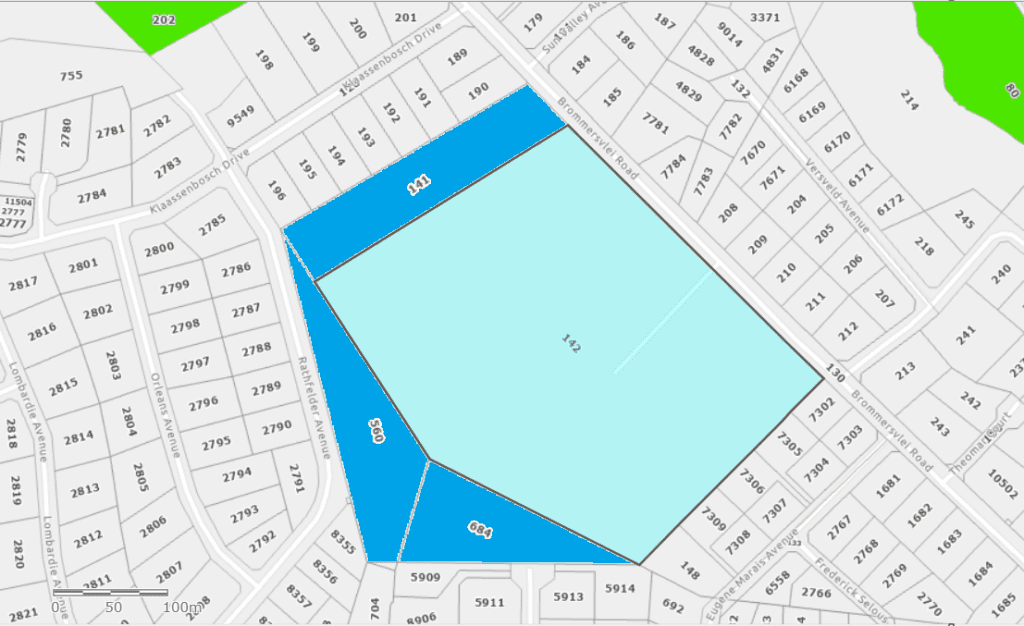
SARDA’s occupation was lawful, though its tenure remained precarious. The organisation had made substantial investments in facilities and infrastructure to support its therapeutic programmes. It maintained that it had received assurances from state officials, including a promise of a 50-year lease in 2011, which created legitimate expectations regarding its continued occupation.
1.3 The Parties
The principal parties in the final Constitutional Court appeal were:
- The Applicant: South African Riding for the Disabled Association (SARDA), seeking to protect its interests as lawful occupier of Erf 142 Constantia.
- The Land Claimants (Respondents): The Sadien family, initially represented by individual descendants (Sediek Sadien and Ebrahim Sadien), later substituted by family trusts representing a broader group of beneficiaries.
- The State (First Respondent): The Regional Land Claims Commission, Western Cape, the statutory body responsible for processing and facilitating land claims.
The tension between these parties – and the constitutional values each represented – would define the contours of this protracted litigation.
2.0 The Land Claims Court Proceedings (2011-2013)
2.1 The Initial Adjudication (2011)
Following South Africa’s democratic transition, various Sadien family members lodged land claims between 1995 and 1998. Between 2001 and 2003, the Regional Land Claims Commission consolidated these individual claims into a single family claim for adjudication.
The Land Claims Court heard the matter and on 19 May 2011 delivered judgment finding:
- The Sadien brothers had been dispossessed of Erf 2274 as a result of racially discriminatory laws and practices
- The compensation received at the time of forced sale (R13,550) was not just and equitable
- The family was entitled to restitution under the Restitution of Land Rights Act 22 of 1994
2.2 The Remedy: Alternative Land (2012)
On 7 December 2012, the Land Claims Court (per Mpshe AJ) addressed the form of restitution:
Findings on restoration of original land:
- The court determined that restoration of Erf 2274 itself was not feasible
- The property had been substantially developed and held development rights valued at approximately R132 million
- The value of the land was estimated between R80-140 million
- Full restoration would be “financially too onerous” for the state
The alternative remedy ordered:
- The court ordered transfer of alternative state-owned land under section 35(1)(b) of the Restitution Act
- The initial order specified Erf 1783 Constantia, believed to be approximately 10 hectares
- The land was to be transferred to Sediek Sadien as representative of the claimants
2.3 The Suo Motu Variation (8 February 2013)
A significant development occurred when the court discovered that Erf 1783 measured only 2.6 hectares, not the assumed 10 hectares. On 8 February 2013, the Land Claims Court acted suo motu (on its own motion) to vary its December 2012 order:
The variation:
- Substituted Erf 142 Constantia (8.9 hectares) for the previously awarded Erf 1783
- Ordered transfer of Erf 142 to Sediek Sadien
- Made the variation without notice to affected parties
The legal significance:
This suo motu variation of what appeared to be a final order raised several questions:
- Whether the court had become functus officio (exhausted its jurisdiction over the matter)
- Whether procedural fairness required notice to SARDA as the long-term occupier of Erf 142
- Whether the court’s power to designate alternative land extended to unilateral substitution
Critically, SARDA – which had occupied Erf 142 since 1980 – received no notice of these proceedings or the variation order directly affecting its tenure.
3.0 SARDA’s Legal Challenge and the Question of Standing (2014-2017)
3.1 SARDA’s Initial Attempts to Intervene
Upon discovering that the land it occupied had been awarded to the Sadien family, SARDA initiated a series of applications seeking to protect its interests:
First attempt – Supreme Court of Appeal (2014):
- On 22 September 2014, SARDA applied to the SCA for leave to intervene and for rescission of the LCC’s orders
- The SCA struck the application from the roll, finding it lacked jurisdiction
- The SCA noted that the pending appeal concerned only costs, not the substantive land transfer order
- Section 35(11) of the Restitution Act requires an appeal to be pending “in respect of such order”
Second attempt – Land Claims Court (2015):
- SARDA brought its intervention and rescission application directly to the LCC
- On 11 September 2015, the LCC dismissed the application
- The court held that SARDA lacked a “direct and substantial legal interest” in the proceedings
- The LCC found SARDA’s interest was “purely financial” rather than a legal interest justifying intervention
SARDA then sought leave to appeal to the Constitutional Court.
3.2 The Constitutional Court’s 2017 Judgment: Defining SARDA’s Interest
On 23 February 2017, the Constitutional Court handed down a judgment that would define the parameters of the dispute for years to come.
The Court’s findings on standing:
The Constitutional Court (per Froneman J) held:
- SARDA did have a direct and substantial interest in the restitution proceedings
- This interest arose from section 35(9) of the Restitution Act, which provides that lawful occupiers displaced by restitution orders are entitled to “just and equitable compensation”
- SARDA therefore had standing to intervene for the purpose of securing compensation
- However, this interest was limited to compensation and did not extend to challenging the transfer of the land itself
Key reasoning:
The court balanced competing considerations:
- SARDA’s 35+ years of lawful occupation created legitimate interests deserving protection
- However, the rights of lawful occupiers “do not trump the rights of claimants to have their land restored”
- Section 35(9) provides the appropriate mechanism for protecting occupiers through compensation
- Allowing broader standing would enable third parties to obstruct constitutionally mandated restitution
The operative order:
The court:
- Granted SARDA leave to appeal and intervene
- Declared that SARDA’s interest was limited to just and equitable compensation under section 35(9)
- Found it “unnecessary to rescind” the LCC’s 2013 varied order
- Remitted the matter to the LCC for determination of appropriate compensation
Implications and ambiguities:
This judgment resolved SARDA’s immediate standing challenge but left several questions:
- What process would determine “just and equitable” compensation?
- Could SARDA participate in proceedings that might affect the quantum of compensation?
- Was the 2017 finding on standing final and immutable, or could changed circumstances warrant reconsideration?
- Did the finding that rescission was “unnecessary” constitute a final determination that the 2013 order was legally valid?
4.0 Post-2017 Developments: Changing Circumstances (2020-2024)
4.1 The 2020 Variation Order
Following the Constitutional Court’s 2017 remittal, significant developments occurred. On [date] 2020, the Land Claims Court (now renamed the Land Court) issued a variation order ([2020] ZALCC 23):
Key features:
- Substituted parties to include family trusts alongside individual claimants
- Ordered that land be transferred “in equal shares” among verified Sadien family members
- Included a suspension clause: transfer was suspended pending determination of just and equitable compensation to SARDA
- Recognised SARDA’s status as an intervener in the proceedings
Significance:
The suspension clause appeared to acknowledge SARDA’s section 35(9) rights and suggest that compensation must be resolved before dispossession could occur.
On 21 June 2022, the Land Court issued an order ([2022] ZALCC 34) formally granting SARDA intervener status in the proceedings.
This created an apparent legal framework where:
- SARDA was recognised as a formal party with standing to participate
- Its rights to compensation were acknowledged
- Procedures existed for it to be heard on relevant issues
4.3 The 2024 Variation Order: Fundamental Changes
On 1 November 2024, the Land Court issued a further variation order ([2024] ZALCC 38) that substantially altered the nature of the relief:
Major changes:
- Multiplication of beneficiaries: Substituted five family trusts as parties, representing approximately 300 individual beneficiaries (compared to the original single representative)
- Equal share distribution: Ordered that the 8.9-hectare property be transferred “in equal shares” to all verified family members
- Reallocation of portions: A 2% portion previously allocated to one individual was redistributed among all beneficiaries
- Suspension maintained: Like the 2020 order, transfer remained suspended pending SARDA’s compensation determination
Practical implications:
The multiplication of beneficiaries raised serious questions:
- Physical subdivision: 8.9 hectares ÷ 300 beneficiaries = approximately 297m² per person
- Whether such subdivision was practically executable
- Whether it was consistent with planning and zoning regulations
- Whether equal shares meant equal physical portions or some form of collective ownership
- How title registration would function with 300 co-owners
4.4 SARDA’s Response: Counter-Application
In response to the trust intervention application, SARDA filed a counter-application seeking:
- Amendment or rescission of the 2012 and 2013 orders to remove Erf 142 from their scope
- Alternative relief if rescission was refused
SARDA’s grounds included:
- The 2024 order was incapable of execution due to the multiplication of beneficiaries
- Changed circumstances since 2017 (intervener status, fundamental changes to relief)
- Procedural irregularities in adding hundreds of beneficiaries without full hearing
- The 2017 Constitutional Court order was wrongly decided or decided per incuriam (through lack of care)
The Land Court’s response:
The Land Court dismissed SARDA’s counter-application, finding:
- SARDA lacked standing to bring the application
- The issues SARDA sought to raise were foreclosed by the 2017 Constitutional Court judgment
- SARDA’s interest remained limited to compensation
This dismissal formed the basis for SARDA’s final appeal to the Constitutional Court.
5.0 The Constitutional Court’s 2025 Judgment: Finality and Standing
5.1 The Application and Issues
SARDA sought direct leave to appeal the Land Court’s 2024 dismissal of its counter-application. The application raised two primary challenges:
- Challenge to the 2024 substitution order: SARDA argued the order was:
- Incapable of execution (300 beneficiaries, indivisible land)
- Incoherent and legally defective
- Made without proper procedural fairness
- Request to rescind the 2013 varied order: SARDA argued the original suo motu variation was:
- Procedurally unfair (no notice to affected parties)
- Beyond the court’s jurisdiction (functus officio)
- Made without proper legal foundation
The threshold issue:
Before reaching the merits, the Constitutional Court had to determine whether SARDA had standing to bring these challenges – a question necessarily informed by the Court’s own 2017 judgment.
5.2 The Parties’ Positions
SARDA’s arguments:
- The 2017 order was interlocutory: SARDA contended that the 2017 finding on standing was not final because:
- It merely addressed SARDA’s right to intervene, not the ultimate merits
- Changed circumstances (intervener status, multiplication of beneficiaries) warranted reconsideration
- The order was capable of variation by the Land Court on good cause shown
- Alternatively, the 2017 order was per incuriam: SARDA argued the 2017 judgment was wrongly decided due to:
- Material non-disclosure (50-year lease promise, full occupation history, planning designations)
- Failure to consider the practical impossibility of executing subsequent orders
- Error in limiting standing to compensation alone
- The interests of justice: SARDA maintained that finality could only be achieved by reconsidering the 2017 order
The Sadien family’s position:
The respondents argued:
- The 2017 order was final and definitive on SARDA’s standing
- SARDA sought an impermissible rehearing of settled issues
- No proper rescission application had been brought
- The interests of justice favoured finality after 60+ years since dispossession
- SARDA’s repeated challenges constituted an abuse of process
The Commission’s position:
The first respondent similarly contended:
- SARDA lacked standing to oppose the trust intervention
- SARDA’s approach amounted to collateral attack on a final order
- The constitutional imperative of restitution required finality
5.3 The Court’s Judgment (Kollapen J)
On 13 November 2025, the Constitutional Court delivered a unanimous judgment dismissing SARDA’s application.
Finding 1: The 2017 order was final, not interlocutory
The court held:
- An order’s finality is determined by its effect, not merely its form or label
- The 2017 order had “final and definitive” effect because it:
- Made a substantive determination of SARDA’s legal interest
- Conclusively limited SARDA’s participation to compensation matters
- Precluded SARDA from seeking any other relief in the restitution proceedings
- This was not merely a procedural ruling but a determination of substantive rights
- No lower court could “alter this Court’s finding after it had pronounced on it”
Finding 2: SARDA lacked standing
Based on the finality of the 2017 order, the court concluded:
- SARDA’s interest remained limited to compensation
- SARDA had no legal interest in:
- The identity of the transferees (whether trusts or individuals)
- The number of beneficiaries
- The structure of the transfer
- The merits of the substitution application
- Therefore, SARDA lacked standing to:
- Oppose the trust intervention application
- Bring a counter-application for rescission
- Appeal the Land Court’s 2024 order
Finding 3: No rescission application
The court noted:
- SARDA had asked the court to depart from its 2017 order
- However, no formal rescission application had been brought
- During oral argument, SARDA’s counsel conceded “one should have been brought”
- Without a proper application, the court could not consider rescission
- In any event, the principles of legal certainty and finality militated against rescission
Finding 4: SARDA’s conduct
The court made strong observations about SARDA’s approach:
- SARDA had “misconceived the extent of its interest” in 2017
- The current application went “beyond a mere misconception to what could only be viewed as a refusal to accept the extent of its interest and a disregard of this Court’s 2017 order”
- This conduct was characterized as “puzzling and somewhat troubling”
Finding 5: The imperative of finality in restitution
The court emphasized:
- Restitution is the means to “address and rectify the injustices of the past”
- “Addressing past injustices and providing equitable redress inherently requires finality”
- The Sadien family was dispossessed in 1963
- Over 60 years later and 13 years after the original award, they still had not received the land
- “Through repeated legal challenges and the disregard for this Court’s 2017 judgment, SARDA has furthered the delay”
5.4 The Costs Order
The court made a significant ruling on costs, departing from the usual Biowatch principle.
The Biowatch principle:
- Generally protects public interest litigants from adverse costs when pursuing constitutional matters against the state
- Based on the principle that access to courts should not be chilled by costs concerns
- Assumes litigants act in good faith and raise genuine constitutional issues
The court’s departure:
The court held that SARDA should not receive Biowatch protection because:
- The Biowatch principle is not unqualified
- It does not apply where litigation is “frivolous or vexatious, or in any other way manifestly inappropriate”
- SARDA’s conduct fell into this category because it:
- Disregarded a final Constitutional Court order
- Impermissibly sought to re-litigate settled issues
- Was “procedurally inept and devoid of merit”
- No fundamental constitutional right against the state was being enforced – the challenge was to beneficiary substitution
Mitigating factors:
The court exercised discretion considering:
- SARDA is a non-profit organisation
- It performs “important work to assist the disability community”
- Therefore, costs were awarded but not costs of two counsel (as requested)
5.5 The Operative Order
The court:
- Dismissed the application for leave to appeal
- Ordered SARDA to pay the respondents’ costs (but not costs of two counsel)
6.0 Analysis: Competing Perspectives and Legal Tensions
6.1 SARDA’s Perspective: Procedural Justice Concerns
From SARDA’s viewpoint, several legitimate concerns emerge:
Procedural fairness issues:
- No notice (2013): The original variation substituting Erf 142 was made without notice to SARDA despite 30+ years of occupation
- Ex parte designation: The court appeared to select and designate alternative land unilaterally
- Changed circumstances: The 2024 order fundamentally altered the relief (1 beneficiary → 300), arguably creating a “new case”
- Broken promises: State officials allegedly promised a 50-year lease in 2011, then awarded the land away
Substantive concerns:
- Impossibility of execution: 8.9 hectares cannot practically be subdivided among 300 people
- Planning law: The District Plan allegedly designates the land for community/educational use (SARDA’s function)
- Social impact: Displacement would end therapeutic services to children with disabilities
- Legitimate expectations: 40+ years of occupation with state acquiescence created reasonable reliance
Legal arguments:
- Functus officio: Did the LCC exceed its jurisdiction by varying a final order suo motu?
- Separation of powers: Did the court usurp executive functions by designating land rather than ordering the state to do so?
- Administrative justice: Were decisions made in accordance with PAJA requirements?
6.2 The Sadien Family’s Perspective: Historical Justice
From the claimants’ viewpoint, equally compelling considerations exist:
Historical injustice:
- Forced dispossession (1962): The family was expelled from land held since 1902 due to racist legislation
- Grossly inadequate compensation: R13,550 for valuable agricultural land was manifestly unjust
- Generational impact: Dispossession destroyed a communal livelihood and displaced entire families
- Constitutional right: Section 25(7) enshrines the right to restitution as a fundamental remedy
Legal entitlement:
- Valid claim: Courts at every level found the dispossession was discriminatory and the claim valid
- Impracticality of restoration: Original land (Erf 2274) valued at R80-140 million, making restoration impossible
- Statutory framework: The Restitution Act expressly provides for alternative land as a remedy
- Family evolution: The substitution of trusts reflects the natural evolution of family structure over 60+ years
Delay and frustration:
- 60+ years since dispossession: The 1962 dispossession occurred over six decades ago
- 13+ years since award: The 2012 judgment still hasn’t been implemented
- Repeated obstacles: SARDA’s challenges have prevented finalization despite multiple court orders
- Justice delayed: Each year of delay denies an aging generation their constitutional right
6.3 The State’s Position: Balancing Act
The state (Regional Land Claims Commission) faced inherent tensions:
Constitutional obligations:
- Restitution mandate: Section 25(7) requires the state to facilitate restitution
- Administrative fairness: PAJA requires lawful, reasonable, and procedurally fair decisions
- Resource constraints: Limited availability of suitable alternative state land
Practical challenges:
- Competing claims: Both parties have legitimate interests deserving protection
- No perfect solution: Any decision necessarily disappoints one party
- Compensation determination: Difficulty in quantifying “just and equitable” compensation for SARDA
6.4 Legal Principles in Tension
The case highlights several competing legal principles:
Finality vs. Correctness:
- The doctrine of res judicata requires finality to prevent endless litigation
- However, manifestly incorrect decisions may perpetuate injustice
- When do interests in finality outweigh interests in correctness?
Restitution vs. Current Occupiers:
- Section 25(7) prioritizes remedying historical dispossession
- Section 35(9) protects lawful occupiers through compensation
- How should courts balance these when both serve important constitutional values?
Procedural Fairness vs. Expedition:
- Affected parties deserve notice and opportunity to be heard
- Restitution delayed is restitution denied
- How much process is due when delay perpetuates historical injustice?
Judicial Power vs. Administrative Function:
- Courts have broad remedial powers in restitution matters
- Separation of powers requires courts not to usurp executive functions
- Where is the boundary between judicial designation and executive implementation?
7.0 Unresolved Questions and Systemic Implications
7.1 Questions Left Unanswered
Several significant legal questions remain unresolved:
On the 2013 variation:
- Was the suo motu variation of a final order legally valid?
- Did procedural fairness require notice to SARDA in 2013?
- Was the court’s designation of alternative land within its statutory powers?
On the 2024 order:
- Is the order capable of practical execution?
- How will 8.9 hectares be divided among 300 beneficiaries?
- What form of ownership is contemplated (co-ownership, subdivision, trust arrangement)?
- Does the order comply with planning and zoning requirements?
On compensation:
- What constitutes “just and equitable” compensation for SARDA?
- Who determines compensation and through what process?
- Does SARDA have standing to participate in compensation determination?
- When must compensation be paid relative to dispossession?
On rescission:
- Could SARDA bring a proper rescission application challenging the 2017 order?
- What would constitute sufficient grounds (per incuriam, material non-disclosure)?
- Would changed circumstances since 2017 be relevant?
7.2 Systemic Implications for Land Restitution
This case reveals broader challenges in the restitution system:
Third-party rights:
- How should restitution processes identify and protect affected third parties?
- What notice and participation rights should occupiers have?
- Can the tension between restitution and occupier rights be better managed?
Alternative land designation:
- What criteria should govern selection of alternative land?
- Should courts designate land or merely order the executive to do so?
- How can disputes over alternative land be resolved expeditiously?
Practical executability:
- Should courts assess whether orders are practically executable before granting them?
- What happens when family groups multiply over decades?
- How should collective/communal ownership be structured?
Compensation mechanisms:
- Should compensation to displaced occupiers be determined before or after the restitution award?
- What factors should inform “just and equitable” compensation?
- How can compensation disputes be expedited?
7.3 The Disability Rights Dimension
An often-overlooked aspect is the impact on persons with disabilities:
SARDA’s social function:
- Provides therapeutic services to children and adults with disabilities
- Serves a vulnerable population with limited alternative service options
- Has invested significantly in specialized facilities and infrastructure
Constitutional implications:
- Section 9(3) prohibits unfair discrimination on the basis of disability
- Section 27 protects rights to healthcare services
- State has positive obligations to protect and promote disability rights
The tension:
- Restitution is a constitutional imperative
- Disability services are a constitutional priority
- Displacement forces a choice between two constitutional values
8.0 Conclusion: A Case Without Winners
The SARDA litigation illustrates the profound complexity of pursuing historical justice in a society still grappling with apartheid’s legacy. The case presents no villains and no heroes – only parties with legitimate interests caught in an impossible situation.
8.1 The Sadien Family: Justice Long Delayed
For the Sadien family, the Constitutional Court’s 2025 judgment represents a legal victory that still leaves them without possession of land 63 years after dispossession. The repeated delays – however well-intentioned SARDA’s concerns – have meant that many who were dispossessed have not lived to see justice. The multiplication of beneficiaries from 1 to 300 reflects both the passage of time and the generational impact of dispossession.
The question remains: will the 2024 order prove executable, or will further litigation delay implementation even longer?
8.2 SARDA: Displacement of a Vulnerable Service
For SARDA and the children it serves, the judgment represents the loss of 40+ years of established operations. The organisation faces displacement from facilities it built and developed, serving a vulnerable population that may have limited alternative options. The promise of compensation – still undetermined – cannot restore what will be lost: established programmes, specialized facilities, and continuity of service.
The suspension clause in the 2024 order offers some protection, but SARDA’s limited standing may constrain its ability to meaningfully participate in compensation determination.
8.3 The State: An Impossible Balancing Act
The state faces the unenviable task of satisfying constitutional obligations to both parties with limited resources and no perfect solutions. Every decision favouring one party necessarily disadvantages the other.
8.4 Broader Reflections on Restorative Justice
This case illustrates fundamental challenges in pursuing restorative justice:
The impossibility of true restoration:
- Time cannot be reversed
- Families evolve and multiply
- Land uses change
- Third parties develop reliance interests
- No remedy can fully restore what was lost
The tension between individual and systemic justice:
- Individual cases can raise valid procedural concerns
- But systemic imperatives may require acceptance of imperfect processes
- Finality serves both individual claimants and the broader restitution programme
The ethical complexity:
- Both SARDA and the Sadien family serve important social goods
- Both have legitimate legal and moral claims
- Any resolution requires one party to sacrifice
8.5 The Role of Finality
The Constitutional Court’s emphasis on finality reflects a hard truth: at some point, litigation must end even when questions remain unanswered. The doctrine serves several purposes:
For claimants:
- Prevents indefinite delay of constitutional rights
- Provides certainty and closure
- Enables life planning and economic development
For the legal system:
- Prevents endless re-litigation
- Preserves judicial resources
- Maintains public confidence in court orders
For society:
- Allows historical wounds to begin healing
- Enables forward progress
- Acknowledges that perfect justice may be impossible
Whether the 2025 judgment strikes the right balance between these competing interests is a question on which reasonable people may disagree.
8.6 Final Observations
Several observations emerge from this lengthy litigation:
- Early notice matters: The 2013 failure to notify SARDA created the foundation for years of litigation. Better procedural safeguards at the outset might have enabled early resolution.
- Changed circumstances complicate finality: The multiplication of beneficiaries and other developments since 2017 created genuine questions about whether earlier orders remained appropriate.
- Compensation should be addressed early: Deferring compensation determination contributed to ongoing uncertainty and litigation.
- Planning for executability is essential: Orders should consider practical implementation challenges before being granted.
- No perfect solutions exist: When constitutional values conflict, any resolution necessarily involves difficult trade-offs.
The SARDA case will likely be remembered both for its clarification of important legal principles and as a cautionary tale about the challenges of implementing restorative justice in complex circumstances where there are no easy answers and no truly satisfactory outcomes.
Whether this judgment represents the conclusion of litigation or merely another chapter remains to be seen. What is certain is that both the Sadien family and SARDA continue to wait – the former for land they were promised, the latter for certainty about their future – whilst the children with disabilities served by SARDA’s programmes await resolution of forces far beyond their control.