

The Prudential Authority: Institutional Overview
In South Africa, the Prudential Authority (PA) is a financial regulator that operates within the South African Reserve Bank (SARB). It was established on 1 April 2018 under the Financial Sector Regulation Act 9 of 2017 (FSR Act) as part of South Africa’s move to a “Twin Peaks” model of financial regulation.
Purpose and Role
The Prudential Authority’s main function is to promote the safety and soundness of financial institutions that provide financial products and services. This is to ensure that these institutions remain stable and that they do not pose risks to the broader financial system.
Its focus is on prudential regulation and supervision, which means:
- Minimizing systemic risks that could harm South Africa’s economy
- Ensuring that banks, insurers, cooperative financial institutions, and other key players are financially sound
- Monitoring their capital, liquidity, risk management, and governance practices
Scope of Supervision
The PA supervises:
- Banks and mutual banks
- Insurers (life, non-life, and reinsurers)
- Cooperative financial institutions (CFIs)
- Financial conglomerates (large groups with banking, insurance, and other financial arms)
Governance Structure
The Governor of the SARB is the head of the PA. The PA operates independently but under the umbrella of the SARB, giving it credibility and resources.
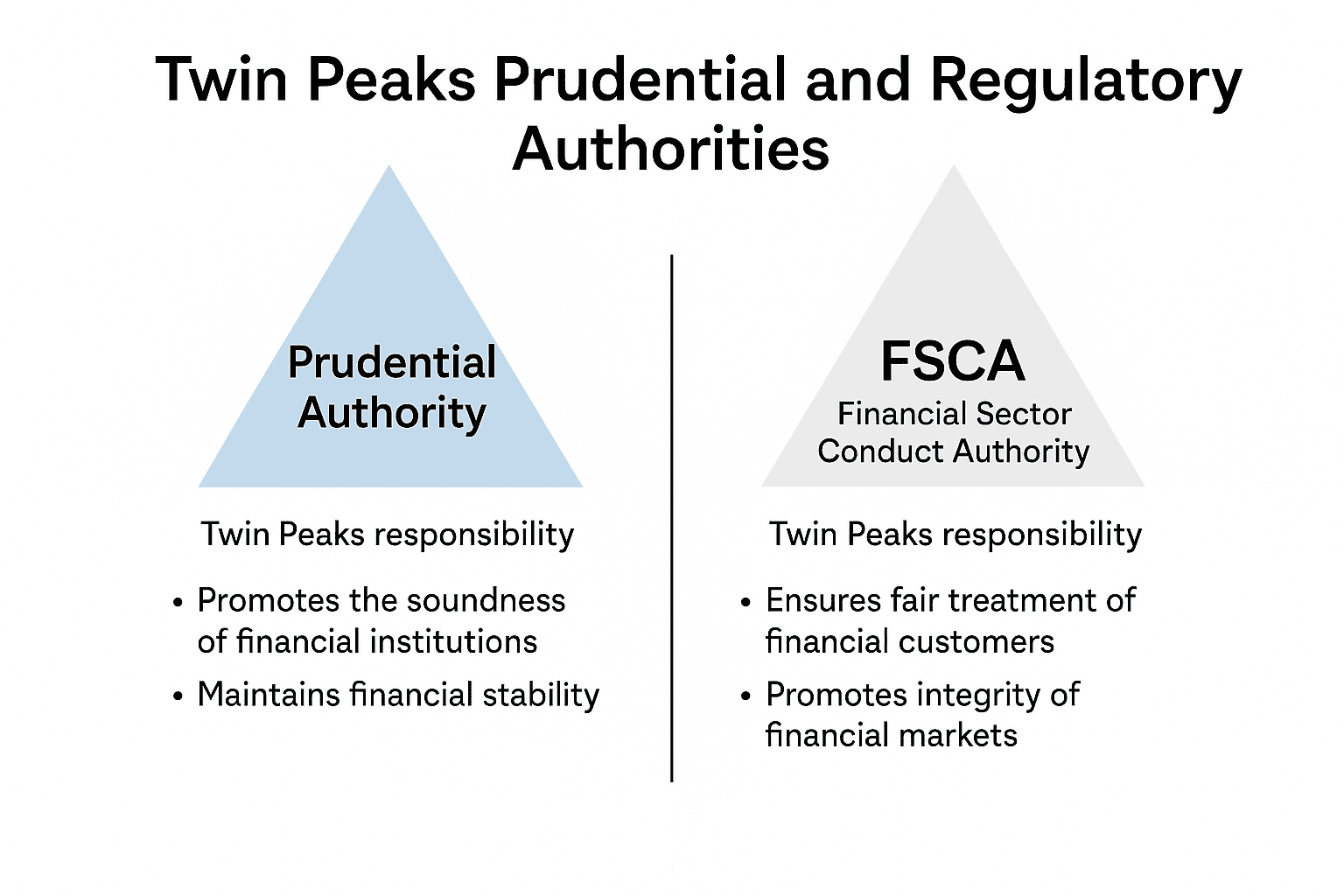
Twin Peaks Model
South Africa’s financial regulation is split between two “peaks”:
- Prudential Authority (PA) — focused on safety, soundness, and stability of institutions
- Financial Sector Conduct Authority (FSCA) — focused on market conduct, ensuring fair treatment of customers, integrity of markets, and preventing misconduct
Together, they replaced the old sectoral approach (separate regulators for banks, insurers, etc.), creating a clearer and stronger regulatory system.
The Prudential Authority is South Africa’s financial regulator for the stability and solvency of banks, insurers, and related institutions. It makes sure these entities do not collapse in ways that could endanger depositors, policyholders, or the financial system as a whole.
Recent Directives and Notices
The following survey of recent directives, proposed directives, and notices issued by the Prudential Authority illustrates the Authority’s evolving regulatory posture. Each instrument is briefly summarised with reference to its principal provisions and their practical implications for banks, insurers, and other regulated entities.
Recent Prudential Authority Directives and Notices
| Name / Reference | Date / Status | Key Requirements/Changes | Who is Affected |
|---|---|---|---|
| Directive D10-2025 (Pillar 3 disclosure requirements) | 12 August 2025 South African Reserve Bank | Enhanced disclosure requirements for risk exposures, capital adequacy, and risk management frameworks | Banks |
| Directive D9-2025 (Prudential treatment of credit exposure secured by forest and agricultural land) | 12 August 2025 South African Reserve Bank | Specific capital treatment for agricultural and forestry-secured lending | Banks and controlling companies |
| Prudential Communication 18 of 2024 (Revised market risk & Credit Valuation Adjustment (CVA) implementation roadmap) | 10 December 2024 South African Reserve Bank | Outlines how and when banks should implement revised market risk requirements and CVA (a method to account for counterparty credit risk in derivatives) under more recent international standards. South African Reserve Bank. Aims to revise requirements for loss-absorbency of Additional Tier 1 and Tier 2 capital instruments. Key features: ability of the Prudential Authority to trigger write-off or conversion of these instruments in a non-viability event (“regulatory bail-in”); clarifies co-existence with statutory bail-in powers in resolution. Will replace former guidance (Guidance Note 6 of 2017). whitecase.com | Banks, especially those with derivative exposures or dealing in market risk |
| Directive 2 of 2025 (Capital treatment of significant investments in insurance entities) | Effective from 1 July 2025 (or with deadline then) saicawebprstorage.blob.core.windows.net | Ensures consistent application of capital adequacy rules for banks that have significant investments in insurance entities. Essentially, how such investments are risk-weighted / treated for capital. saicawebprstorage.blob.core.windows.net | Banks with insurance entity exposure |
| Proposed Directive: Completion of Regulatory Return: Form BA 701 | Issued / effective 1 July 2025 (Proposal)saicawebprstorage.blob.core.windows.net | Directs domestic systemically important banks (D-SIBs) and controlling companies to complete Form BA 701 (capital and economic capital info: total credit risk, market risk, operational risk etc.), at both solo and consolidated levels, on a semi-annual basis (30 June / 31 December), with deadlines. saicawebprstorage.blob.core.windows.net | D-SIBs / large banks |
| Insurers Directive ID1 of 2022 | 2022 South African Reserve Bank | Requirement for life insurance companies to obtain the identity of beneficiaries of life insurance policies. (Part of broader anti-money laundering / customer due diligence measures). South African Reserve Bank | Life insurers |
Why These Matter
Recent regulatory measures illustrate the Prudential Authority’s concerted effort to strengthen risk-management and transparency, particularly for institutions with complex exposures such as market risk, credit valuation adjustment, and sector-specific lending to areas like agriculture. A key trend is the reinforcement of loss-absorbency capacity, requiring that Additional Tier 1 and Tier 2 capital instruments be capable of conversion or write-down at the point of non-viability or resolution, in line with international standards. Enhanced reporting and disclosure obligations further reflect this approach, with more frequent submissions, expanded datasets, and consistent treatment across solo and consolidated entities. In the insurance sector, supervisory priorities continue to emphasise solvency, beneficiary identification, and risk-sensitive oversight.
Prudential Authority Directives: Pillar 3 and Loss Absorbency
Set out below are summaries and selected excerpts from Directive D10-2025 (Pillar 3 disclosure requirements) and the Proposed Directive on Loss Absorbency Requirements. Each summary highlights the key obligations, with attention to which provisions are already binding and which remain subject to consultation.
Regulatory Disclosure Requirements: South Africa’s Banking Transparency Framework
South African banking regulation incorporates comprehensive disclosure requirements that serve as a cornerstone of financial system stability and public confidence.
Regulatory Framework
The disclosure regime mandates that all registered banks publish standardised regulatory reports detailing their risk exposures, capital adequacy, and risk management frameworks. This regulatory transparency mechanism operates under the oversight of the Prudential Authority, which prescribes specific reporting templates and disclosure frequencies.
Rationale and Public Interest
The banking sector’s foundational reliance on public trust necessitates comprehensive transparency measures. Information asymmetries between financial institutions and stakeholders—including depositors, investors, and regulatory authorities—can precipitate systemic instability. The mandatory disclosure framework mitigates these risks by ensuring material banking risks and financial positions are publicly accessible, thereby preventing the concealment of institutional vulnerabilities that could undermine market confidence.
Compliance Obligations
Banks must complete prescribed Prudential Authority templates according to specified reporting cycles, typically quarterly or annually depending on the nature of the information required. These standardised reports encompass:
- Credit risk exposures across economic sectors and counterparty categories
- Market risk positions, including interest rate and foreign exchange exposures
- Capital adequacy ratios and regulatory capital composition
- Corporate governance structures and risk oversight mechanisms
- Operational risk management frameworks
Regulatory Outcome
This framework ensures that banking institutions provide standardised, comparable financial disclosures to both regulatory authorities and the public, enabling informed decision-making and effective prudential supervision within South Africa’s financial system.
Proposed Directive on Loss Absorbency Requirements
The Proposed Directive on Loss Absorbency Requirements addresses the regulatory treatment of banks approaching non-viability. Under the current framework, Additional Tier 1 (AT1) and Tier 2 (T2) capital instruments are intended to absorb losses before public funds are exposed. However, earlier guidance issued in 2017 left uncertainty as to the precise circumstances in which these instruments could be written down or converted into equity.
The new proposal seeks to clarify this position. It empowers the Prudential Authority to compel the write-down or conversion of AT1 and T2 instruments at the point of non-viability, thereby implementing a “regulatory bail-in” mechanism as distinct from a state-funded bailout. Investors must be explicitly advised that such instruments may be subject to loss in order to safeguard the stability of the institution. These provisions are designed to operate alongside the statutory bail-in powers introduced by the Financial Sector Laws Amendment Act, which confer additional authority on the Reserve Bank in its role as resolution authority.
In essence, the directive reinforces the principle that losses in a failing bank should be borne by its investors rather than its depositors or the taxpayer.
Regulatory Analogies: Understanding Disclosure and Loss Absorption Mechanisms
Disclosure Requirements as Preventive Transparency
The regulatory disclosure framework operates on principles analogous to preventive healthcare monitoring. Just as regular medical examinations provide stakeholders with objective evidence of an individual’s health status, mandatory banking disclosures furnish regulators, investors, and depositors with standardised metrics demonstrating institutional financial health. This systematic transparency enables early identification of potential vulnerabilities and informed assessment of institutional stability.
Loss Absorbency as Internal Risk Mitigation
Loss absorption mechanisms function similarly to comprehensive personal insurance arrangements with clearly defined liability hierarchies. Under such arrangements, an individual’s personal assets and contingency reserves are exhausted before external parties assume financial responsibility. In the banking context, loss absorption requirements ensure that shareholders’ equity and specified debt instruments bear losses during periods of financial distress, thereby protecting depositors and preventing the socialisation of institutional failures through public bailouts.
These regulatory principles collectively establish a framework wherein financial institutions maintain transparency regarding their risk profile while internalising the consequences of excessive risk-taking, thereby promoting market discipline and systemic stability.
Case Study: Regulatory Framework Application in Banking Crisis Management
The following scenario demonstrates the practical application of South Africa’s prudential regulatory framework, specifically illustrating the operation of Directive D10-2025 (Pillar 3 disclosure requirements) and proposed loss absorbency mechanisms in managing institutional distress.
Hypothetical Case: Major Banking Institution in Financial Distress
Phase 1: Standard Regulatory Compliance
During normal operations, a systemically important South African banking institution maintains regular business activities across diverse sectors including retail lending, corporate finance, agricultural credit, and mining sector exposure. Under Directive D10-2025 implementing Pillar 3 requirements, the institution publishes quarterly disclosure reports containing:
- Capital adequacy ratios demonstrating regulatory compliance (for example, maintaining 13% against the minimum requirement of 10.5%)
- Sectoral credit exposure breakdowns
- Market risk positions, including foreign exchange and interest rate sensitivities
- Corporate governance and risk management structures
These standardised disclosures enable market participants, depositors, and regulatory authorities to conduct ongoing institutional health assessments, promoting market discipline through transparency.
Phase 2: Early Warning Indicators
Following adverse macroeconomic developments, such as a significant commodity price decline, the institution experiences substantial credit losses within its mining sector portfolio. Consequently, its capital adequacy ratio approaches regulatory minimums. The Prudential Authority, monitoring these developments through both public disclosures and supervisory reporting, implements corrective measures including:
- Capital raising requirements through equity issuance
- Dividend distribution restrictions
- Enhanced supervisory oversight
These interventions represent preventive regulatory action designed to restore financial stability before institutional failure occurs.
Phase 3: Point of Non-Viability Declaration
Despite regulatory intervention, continued deterioration in the institution’s financial position results in inability to meet operational obligations, triggering application of the proposed Loss Absorbency Directive. Upon the Prudential Authority’s determination that the institution has reached the point of non-viability, mandatory loss absorption mechanisms activate:
The institution’s Additional Tier 1 and Tier 2 capital instruments become subject to either write-down or conversion to ordinary shares, as prescribed by their contractual terms. This process ensures that private investors who accepted enhanced returns in exchange for bearing contingent loss risk absorb institutional losses rather than depositors or public funds.
Phase 4: Resolution Procedures
Should loss absorption mechanisms prove insufficient, the South African Reserve Bank may exercise statutory resolution powers under the Financial Sector Laws Amendment Act, including institutional restructuring, asset transfers to solvent institutions, or additional creditor loss allocation through bail-in procedures.
Regulatory Framework Synthesis
Preventive Oversight: Directive D10-2025 establishes systematic transparency requirements enabling early identification of institutional vulnerabilities.
Loss Allocation: Loss absorbency mechanisms ensure that sophisticated investors, rather than depositors or taxpayers, bear the financial consequences of institutional failure.
This integrated approach maintains systemic stability while preserving market discipline by ensuring that risk-taking entities and their voluntary creditors internalize the costs of excessive risk exposure.
Regulatory Evolution: African Bank Crisis Analysis Under Contemporary Framework
Historical Context: African Bank Limited Collapse (2014)
African Bank Limited operated as a specialist unsecured lending institution, maintaining concentrated exposure to high-risk personal credit markets. The institution’s business model proved unsustainable during adverse economic conditions, culminating in reported losses of R8.5 billion in August 2014. The South African Reserve Bank subsequently placed the institution under curatorship, implementing a resolution strategy involving:
- Segregation of performing and non-performing assets through a “good bank/bad bank” structure
- Recapitalisation of the viable entity through combined public and private funding
- Protection of depositor interests while imposing losses on wholesale creditors
- Partial public sector financial support totalling approximately R7 billion
This resolution approach, while preserving systemic stability and depositor protection, resulted in material taxpayer exposure through central bank intervention.
Contemporary Regulatory Framework Application
Enhanced Transparency Requirements (Directive D10-2025)
Under current Pillar 3 disclosure obligations, African Bank would have been required to publish comprehensive quarterly reports detailing its risk concentration in unsecured lending markets and deteriorating capital adequacy metrics. This standardised transparency would have provided market participants and supervisory authorities with earlier warning indicators, potentially enabling:
- Proactive capital raising initiatives
- Portfolio diversification requirements
- Enhanced supervisory intervention prior to critical deterioration
Loss Absorption Mechanisms
The institution’s subordinated debt instruments, functionally equivalent to contemporary Additional Tier 1 and Tier 2 capital, would have been subject to mandatory write-down or equity conversion upon the Prudential Authority’s point of non-viability determination. This regulatory bail-in would have immediately strengthened the institution’s capital position without requiring public sector financial support.
Statutory Resolution Framework
Should initial loss absorption measures prove insufficient, the South African Reserve Bank would possess comprehensive statutory bail-in powers under the Financial Sector Laws Amendment Act, enabling systematic creditor loss allocation while maintaining operational continuity and depositor protection.
Comparative Analysis: 2014 versus Contemporary Framework
2014 Resolution Limitations: The absence of comprehensive bail-in mechanisms necessitated R7 billion in public sector support to maintain systemic stability, despite investor losses on subordinated instruments.
Contemporary Framework Advantages:
- Mandatory contingent capital write-down or conversion would absorb losses through private investor funds
- Statutory bail-in powers would enable further creditor loss allocation if required
- Enhanced depositor and taxpayer protection through systematic private sector loss absorption
Regulatory Policy Implications
The contemporary prudential framework specifically addresses the African Bank precedent by ensuring that:
- Preventive Supervision: Enhanced disclosure requirements enable early intervention before institutional failure
- Private Risk Absorption: Contingent capital instruments ensure sophisticated investors bear primary responsibility for institutional losses.
- Public Interest Protection: Comprehensive bail-in powers minimize taxpayer exposure while preserving systemic stability
This regulatory evolution reflects international best practices in banking resolution, prioritizing market discipline while maintaining financial system integrity through systematic private sector loss allocation mechanisms.
Conclusion
The integration of enhanced disclosure requirements under Directive D10-2025 with the proposed loss absorbency framework represents a fundamental shift in South African banking regulation. This comprehensive approach addresses the regulatory gaps exposed by the African Bank crisis while aligning with international best practices in prudential supervision and bank resolution. The framework prioritizes market discipline and private sector risk absorption, thereby protecting depositors and minimizing potential taxpayer exposure while maintaining financial system stability.
© 2025 Warner Attorneys